

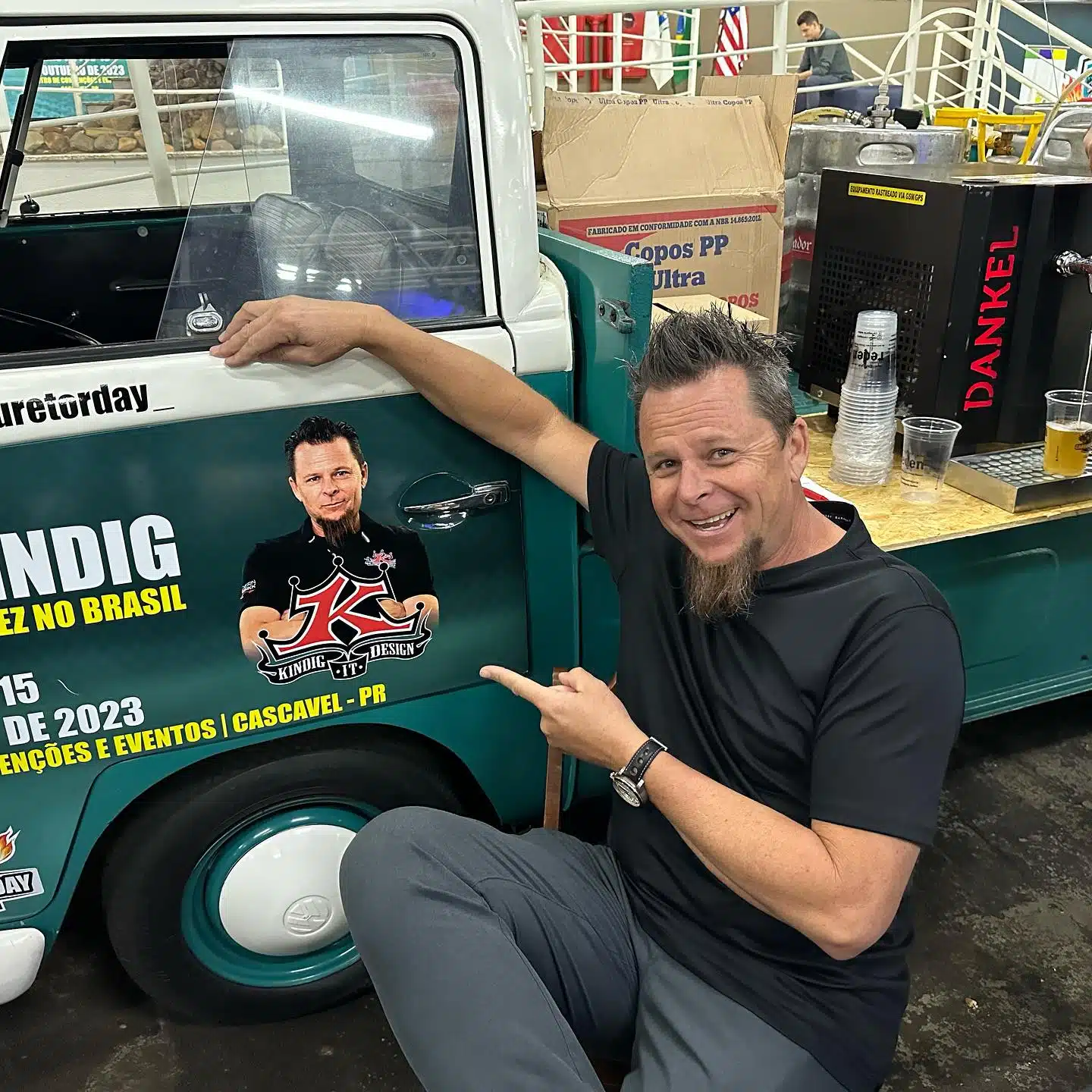
Early life and origin of Kindig‑It Design
Childhood inspirations and early work. Dave Kindig grew up in Rose Park (Salt Lake City) and often tells interviewers that he loved Legos, Hot Wheels and drawing. In a 2017 interview he said he built plastic models and used his imagination to visualize cars before building them [source]. He read Hot Rod, Motor Trend and Car and Driver magazines at the local library and attended Autorama shows to study design [source]. While working at High Performance Coatings (HPC) for 8½ years, Kindig learned fabrication and coating techniques; he quit in June 1999, cashed in his 401(k) for about $4,800, and started Kindig‑It Design with his wife Charity [source]. They sublet a 4,500 sq‑ft workspace, but the business eventually grew to occupy (and own) a 27,000 sq‑ft facility [source]. This start‑up story—self‑funded with retirement savings—fits the narrative of a scrappy, self‑made entrepreneur.
Design ethos. Kindig describes his design philosophy as combining the “classic feel” of vintage cars with modern fit and finish. He avoids trendy features and focuses on timelessness so that a car built today will still look good decades later [source]. He credits his wife Charity, his mother, his sheet‑metal‑working grandfather Marvin Tippetts and custom car legends like George Barris, Boyd Coddington, Chip Foose and Troy Trepanier as influences [source]. His ability to visualize designs before fabricating them stems from his childhood experiments with Lego and model kits [source].
Company growth. Kindig‑It Design started as a small custom shop but has grown into an enterprise employing over 40 staff and occupying a campus that includes a 27,000‑sq‑ft shop plus a 10,000‑sq‑ft warehouse and interior shop [source]. In 2014 the company became the subject of the reality TV series Bitchin’ Rides (Velocity/Motor Trend), which significantly increased its visibility. Kindig reports that before the show aired they had a one‑year backlog, but after the first season the waiting list ballooned to almost four years [source]. The shop builds more than 300 custom cars and features them on the TV program [source].
Bitchin’ Rides and media exposure
Launch and brand impact. Producers discovered Kindig when he was restoring a rare 1939 GM Futurliner; they pitched a show that debuted in 2014. Kindig enjoys being on camera and letting viewers watch the design process [source]. Unlike earlier automotive reality shows such as Pimp My Ride (known for outlandish modifications and behind‑the‑scenes issues [source]) or American Hot Rod (notorious for its drama and high staff turnover [source]), Bitchin’ Rides focuses on craftsmanship and avoids manufactured conflict. A Hot Rod magazine tour of the Kindig‑It shop noted that the company has produced “over 300 builds” and is “celebrating 25 years” while “avoiding TV drama,” which likely contributes to its popularity [source]. The show’s success created a four‑year backlog for custom builds and established Kindig as a national brand.
Earnings from television and merchandise. While Motor Trend has not disclosed salaries, celebrity‑net‑worth sites estimate that Kindig earns about $50,000 per episode of Bitchin’ Rides and value his net worth around $3 million [source]. Another biography site lists his net worth at $5 million [source]. These figures should be viewed as approximations rather than audited accounts; however, they illustrate that TV exposure provides significant income in addition to build commissions. The show also feeds a merchandise business. Kindig sells apparel and a line of patented flush‑mounted door handles priced around €513 (~US$550) per pair; they are handcrafted, come in bare metal or polished chrome, and require buyers to supply vehicle details [source]. The handles are covered by U.S. Patent 8,544,904 and similar patents; they allow a low‑profile handle to pivot on a fulcrum to actuate the latch [source].
Color and paint licensing. In 2017 AkzoNobel’s annual report highlighted a partnership with Dave Kindig to create Modern Classikk, a custom automotive paint line. The report stated that the company teamed up with the “celebrity hot rod builder” and launched a 26‑color range of paints “never seen on the road before” [source]. The collaboration leverages Kindig’s design reputation while giving him a new licensing revenue stream and aligning the brand with a global coatings manufacturer.
Tourism and final season. Kindig‑It Design offers shop tours (for a small fee), adding another income source. In early 2025 the company announced that season 11 will be the final season of Bitchin’ Rides [source], signaling a pivot away from the TV format. The final season may free the team to focus on high‑end builds, licensing and other ventures.
Custom builds and financial footprint
Price range and backlog. Custom builds at Kindig‑It are expensive: Kindig tells reporters that he sells “expensive cars that [customers] don’t need,” with projects running into six figures and some half‑million‑dollar cars [source]. The backlog is around four years [source], meaning clients typically pay large deposits and wait multiple years for delivery.
High‑profile builds:
- Kindig CF1 roadster: In 2021 the company launched the CF1 series—a carbon‑fiber reinterpretation of the 1953 Corvette. Demand surged, with a reported four‑year wait list and price tags over US$550,000 [source]. At auction, CF1 #8 sold for $572,000 at Barrett‑Jackson Scottsdale (Jan 2023), CF1 #5 fetched $770,000 at Mecum Kissimmee (Jan 2024), and CF1 #4 sold for $605,000 in January 2024 [source] [source]. These figures demonstrate that Kindig’s cars can appreciate and command strong resale values.
- TwelveAir (‘53 Corvair concept) – 2024 Ridler Award winner: Street Muscle Mag reports that the TwelveAir was built by Kindig‑It over four years and features a hand‑formed aluminum body, a custom 9.2‑L V‑12 LS engine, Indy‑car–inspired suspension, and one‑off wheels [source]. The build won the prestigious Ridler Award at the Detroit Autorama in 2024. Such show‑car projects showcase Kindig’s design innovation and enhance his brand equity, though they may not be profitable on their own.
Merchandise and licensing revenue. In addition to car builds and TV income, Kindig monetizes his brand through:
- Patent‑licensed parts: flush‑mounted door handles (U.S. Patents 8,544,904; 8,894,109; 9,624,698) used in custom builds and sold to other builders [source]. At roughly $550 per pair, high sales volume could yield six‑figure annual revenue.
- Paint line: Modern Classikk provides licensing royalties from paint sales. AkzoNobel’s partnership indicates the range includes 26 colors and leverages Kindig’s reputation [source].
- Apparel and collectibles: T‑shirts, hats, posters and die‑cast models sold through Kindig’s online store.
- Tours and appearances: Paid shop tours and speaking engagements; his celebrity status commands appearance fees at car shows and trade fairs.
Net worth trajectory. The combination of build fees, TV salaries, merchandise, licensing and appearances has made Kindig a multi‑millionaire. Biographical sites estimate his net worth between US$3 million and US$5 million [source] [source]. While such estimates are not audited, they reflect the scale of earnings typical for a small manufacturing business with global media exposure. The net worth likely rose significantly after the TV show began in 2014; four‑year backlogs for cars priced above $250,000 suggest annual revenue well into the eight‑figure range. However, custom builds are labor‑intensive and capital‑heavy (requiring specialized equipment and dozens of employees), so margins may be modest. Licensing (paint, door handles) offers higher margins and recurring income.
Legal and reputational challenges
2015–16 patent dispute with Creative Controls (CCi)
In 2014 Kindig‑It filed suit against Creative Controls, Inc. (CCi), alleging copyright and patent infringement and false advertising. CCi had donated a parking brake for a Kindig project and later used photos of the completed car in its marketing. The U.S. District Court for Utah considered whether it had personal jurisdiction over the Michigan‑based CCi. The court found that CCi’s contacts with Utah consisted of (1) operating a website that allowed purchases by customers anywhere; (2) donating the custom parking brake and receiving photographs with permission to use them for promotional purposes; (3) making a single sale of a door handle to a Utah customer at Kindig’s request; and (4) allegedly copying photographs from Kindig’s website [source]. Because these contacts were minimal, the court dismissed the patent infringement claims for lack of personal jurisdiction but allowed the copyright and false advertising claims to proceed [source]. The case demonstrates the difficulty of enforcing patents against out‑of‑state defendants; although the financial stakes are unclear, it likely cost both sides legal fees and highlighted the importance of protecting proprietary designs through proper agreements.
Other alleged controversies
Various blogs claim that Kindig faced a 2022 lawsuit from chiropractors over a delayed $670,000 build and general allegations of fraud. There are no mainstream news reports or court documents verifying these claims, so they should be treated cautiously. The only documented legal dispute is the CCi case described above.
Reputation and risk management
Working in a niche industry where craftsmanship and customer relationships are paramount, Kindig’s brand depends on reputation for quality and honesty. Long wait times and high prices can create customer frustration, while reality TV exposure invites public scrutiny. The CCi dispute shows the importance of clear contracts and consent when using images or parts supplied by others. Unverified allegations highlight how quickly rumors can damage a brand; transparency and communication are essential to maintain customer trust.
Cultural and economic context
Early 2000s automotive reality boom. Kindig’s ascent occurred alongside a boom in reality automotive television. Shows like Pimp My Ride (2004–2007) offered sensational modifications and were later criticized for poor craftsmanship and negative participant experiences [source]. American Hot Rod (2004–2008) became known for on‑camera conflict and high turnover [source]. These programs emphasized entertainment over precision. Kindig’s Bitchin’ Rides emerged in 2014 during a second wave of automotive reality shows that focused more on authentic craftsmanship (e.g., Fast N’ Loud, Overhaulin’). This shift coincided with a cultural trend favoring artisanship and bespoke products.
Entrepreneurship and craftsmanship. Starting a custom car business in 1999 required capital, equipment and network building. By leveraging his skills, investing his personal savings, and delivering high‑quality work, Kindig built a reputation that attracted wealthy clients. The early 2000s saw West Coast Customs and other shops parlaying celebrity car builds into lucrative brands; West Coast Customs reportedly had $10 million in revenue by 2008 [source], showing that custom shops could generate substantial income when paired with media exposure. Kindig followed a similar path but differentiated his brand by focusing on timeless design and a drama‑free work environment.
Lessons and assessment
- Turning passion into a business requires financial risk. Kindig started with only $4,800 from his retirement savings [source]. Scaling a custom shop to 27,000 sq ft required reinvestment of profits and building long‑term client relationships.
- Media exposure can be an accelerant and a trap. Bitchin’ Rides brought national fame and a four‑year backlog [source], but it also created expectations and invites scrutiny. Ending the show after season 11 may allow Kindig to refocus on craftsmanship.
- Diversification through licensing and merchandising stabilizes revenue. Patented parts (door handles), paint lines (Modern Classikk) and apparel sales generate recurring income beyond one‑off car builds [source] [source].
- Protecting intellectual property is essential. The CCi lawsuit illustrates that enforcing design patents across states is challenging, especially when contacts are minimal [source]. Clear agreements and trademark registration help protect creative assets.
- Reputation risk in niche industries is high. In custom car building, delays or disputes can quickly tarnish a brand. Transparent communication and quality control are vital.
Summary
Dave Kindig’s journey from a Lego‑obsessed kid to founder of a globally recognized custom car brand illustrates how passion, craftsmanship and media can combine to create wealth. By focusing on timeless design, investing personal capital and embracing reality TV, he turned a small shop into a multi‑million‑dollar enterprise with diversified revenue streams. Kindig’s story also highlights the challenges of protecting intellectual property and managing reputation in a niche industry.




Leave a Comment